4 Recommendations for Mapping Solution Optimization and Cost Reduction
The integration of map data and geospatial solution is foundational to location-based services. However, the increasing complexity of licensing models, map features, and API functions has created significant operational and financial inefficiencies for many businesses. This report identifies four core challenges faced by companies utilizing map services and outlines a data-driven advisory approach to mitigate these risks and achieve substantial cost savings.

Core Challenges in Maps Strategy
Our analysis of industry trends and client pain points reveals four consistent areas of friction that lead to unnecessary expenditure and technical misalignment:
Challenge 1: Inefficient Legacy Licensing and Overpayment
- Analysis: Many enterprises are locked into long-standing relationships with their original map providers since initial development phases. With resources constantly stretched by the current development and operation of their services, it is challenging for them to proactively review new map vendors and solutions to pursue cost and feature efficiency. Consequently, the existing contract terms might be imposing unnecessarily high costs on location-based service operators.
- Recommendation: A Piece of Map‘s research indicates that up to 40% of map licensing expenditure can be reduced by proactively migrating to optimally priced providers that still meet or exceed current data and functional requirements.
Challenge 2: Sourcing Full Feature Packages Despite Underutilized Data Assets
- Analysis: Service providers frequently bundle comprehensive data features (e.g., full Place information including photos, ratings, credit card acceptance details, and more). While attractive for location-based service providers, not every application requires all detailed features; it might only need basic identifiers, such as Place names or simple coordinates.
- Recommendation: A thorough assessment of usage patterns is required to understand the minimum necessary data features for your service. Selecting an optimized API/SDK package based on this assessment is crucial to avoid involuntary payment for unused data features and unnecessary API calls.
Challenge 3: Difficulty in Translating Business Needs to Map Specifications
- Analysis: While software developers are experts in their domain, they often struggle to navigate the specialized nomenclature of the mapping sector (e.g., Points of Interest, Geocoding, Route Optimization, etc.). This knowledge gap can lead to the selection of over-engineered or quickly inadequate solutions.
- Recommendation: Utilizing a dedicated map domain expert bridges this gap, ensuring the selected map solution precisely supports both current service requirements and future scaling projections without costly trial-and-error.
Challenge 4: Resource-Intensive Map Data Sourcing and Procurement
- Analysis: Some location-based service companies require self-acquisition and maintenance of map data for specific use cases. Identifying and validating specialized map data (e.g., unique country coverage, niche attributes) demands considerable internal research and procurement resources. Engaging with multiple vendors for data quality evaluation and legal due diligence is highly time-consuming.
- Recommendation: Adopting one-stop-shop, expert-led sourcing process is essential for efficiency. This approach offloads resource-heavy research, enabling internal teams to focus on core product development.

A Piece of Map’s Methodology for Optimization
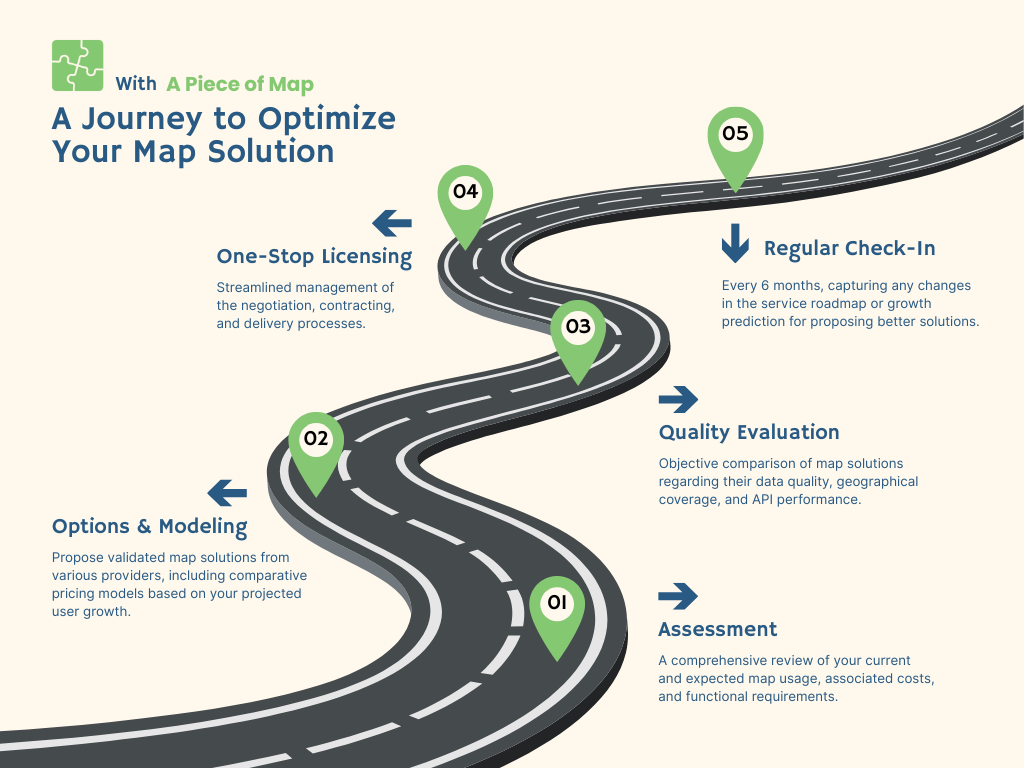
To comprehensively address these challenges, we have developed a structured, five-phase advisory process focused on deep analysis and precise solution design:
- Phase 1 – Map Solution Assessment & Challenge Understanding: A comprehensive review of your current and expected map usage, associated costs, and functional requirements. (Start now Phase 1 with our free Map Solution Assessment)
- Phase 2 – Solution Options & Pricing Scenario Modeling: Compilation of validated map solutions from various global and regional providers, including detailed comparative pricing models based on your projected user growth.
- Phase 3 – Quality and Coverage Evaluation: Objective evaluation and comparison of map solutions regarding their data quality, geographical coverage, and API performance tailored to your specific service needs.
- Phase 4 – One-Stop Licensing & Implementation Support: Streamlined management of the negotiation, contracting, and delivery processes.
- Phase 5 – Regular Check-In: A formal assessment of the client’s business environment every 6 months to capture any changes in the service roadmap or growth prediction, proposing better solutions for the new environment, if necessary.
Conclusion and Next Steps
Achieving cost efficiency and technical superiority in map adoption requires a strategic shift from reactive purchasing to proactive, usage-based optimization. Our methodology ensures that your geospatial investment is perfectly aligned with your business objectives, maximizing your return on investment.
Action Now:
Share your current status via our 5-minute survey. You will receive a preliminary list of alternative map solutions for potential budget savings and technical optimization.
➡️ Take 5 minutes for Map Solution Assessment and get the optimized map solution options and pricing information – It’s free!